
File Reviews & Birth Search in the Age of NCRC: Part 2
In this two-part series, program manager and Korean adoptee Liz Kwon personally reflects on how birth search and file reviews are being handled since NCRC took over adoptee files earlier in 2025. Part 2 focuses on DNA drop off and file reviews with NCRC.Read Part 1 here.
Just after the start of Korean Ties First Wave, I walked with some adoptees to the police station to drop off DNA samples. Like a lot of things in Korea, there are forms that need to be filled out before anything can happen. As I sat there with the adoptees, the police officer pointed out where to fill out names, addresses, check boxes, and to sign. I asked, “How many matches were there last year?”
The police officer replied, “two.”
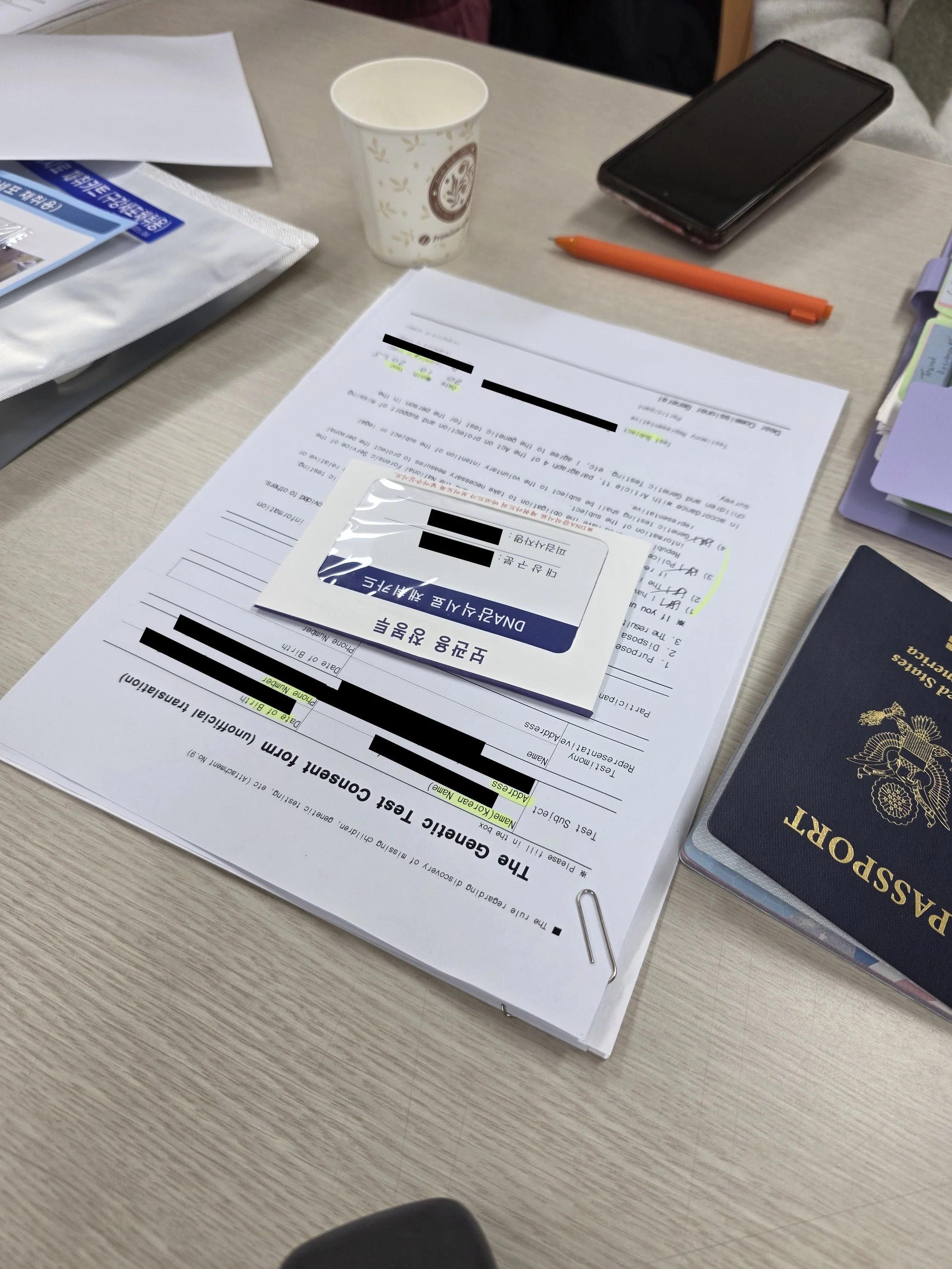
Adoptees hand over their completed forms and DNA samples.
As many Korean adoptees know, the Korean government now holds all of our adoption records. Instead of adoptees going to each respective agency, they now have to contact NCRC directly - fill out forms on both the English and Korean site - and essentially wait to hear back. NCRC will also issue DNA and F4 certificates - something that used to be handled by the Korean agency (Holt, Eastern, SWS or KWS) and send out the three postcards to your birth parent(s) if you want to initiate a reunion.
When Ties first announced the First Wave tour, we knew the file transfer between the adoption agencies and the government would be rough. We also had no idea what to expect, exactly: the information NCRC put out made sense to them but did not make sense to adoptees. And once you tried to access the site, it wasn’t clear what to do. Tanya, the owner of Ties, had to personally dissect the information herself and distribute it to the adoptees on our tour so it would make sense for those who wanted to complete a file review.
Despite Tanya’s help, the adoptees had to submit their information two or three times minimum, before NCRC could find the request. After the request was found, there was more bureaucracy and hoops - requests need to be reviewed before NCRC will allow the adoptee to move forward with anything. At the end of the day, file reviews were completed but for some, the process was too frustrating and the request was abandoned.
Still, there were enough adoptees who wanted to do a file review for half of the day to be blocked off. I joined the adoptees in the room at NCRC as a Ties representative for emotional support to the adoptee traveling with us - to help ask questions and to advocate for the adoptee based on their story. In addition, a G.O.A.’L. case worker joined each of the reviews as they were able to touch the files directly, reading and interpreting the files alongside the NCRC representative. I believe that the adoptees would have been allowed a secondary person in the room beyond our Ties staff, such as a translator or Korean national they trusted, however, every NCRC staff member I interacted with had a good command of English.
After you step off the elevator at NCRC, you are greeted with this sign.
The reviews I sat in did not garner very much new news - there were a couple of new documents that the agencies had not disclosed that the NCRC representative showed the adoptees but they did not have anything actionable on them. The adoptees also received a copy of their file, minus any sensitive information - there is the Korean privacy law that takes precedence and even applies to adoptee’s adoptive parents’ information. The reviews that Tanya sat in gleaned more information, enough that an impromptu search day was arranged for one adoptee as well as a document being found at the local government that never made it to the central government for another adoptee.
The process with NCRC definitely still has some roadblocks - the website that adoptees have to use is clunky and having to switch to the Korean site to make an appointment is not clear. Additionally, once on the Korean site, the dates were wrong because time zone differences weren’t taken into account. Having adoptees submit their information over and over because it cannot be found is another concern - at the time of our tour, there was no way to really tell if your information was received on both sides. Ties had the help of G.O.A.’L for the file reviews because we were a group - something that the NCRC didn’t seem to understand or be willing to accommodate at first. And, as always, it seems that the file review will entirely depend on who reviews it with you. Just like there were more empathetic social workers than some at the agencies, the same applies to NCRC. Fortunately the NCRC employees I interacted with seemed to want to help as much as they could without getting fired - however, there are still limitations: for one adoptee, the name of their parent was in the file (but not their ID number) and NCRC said they did not have the manpower to conduct a search.
That adoptee left the NCRC in tears and chose to spend the rest of the day alone - something that is completely understandable and acceptable. There is nothing like learning you can have so much more if only the person or entity who holds all the cards would be willing to fight for you: your human rights, your dignity, your past, and your future. If only everyone who was in a position to help us was like the orphanage representative in Mokpo - wanting answers as much as adoptees.
Ties offers three heritage tours to Korea - Korean Ties (all ages), Korean Ties 21+ and Korean Ties First Wave (ages 50+). View our heritage tour page to learn more or sign up for more information here.
Want to ask questions about the process in person? Join Ties and G.O.A.’L. for our presentation, Finding Roots and Finding Files at KAAN 2026 in Denver, Colorado. Follow wearekaan.org for registration information.